
Newsroom

Conference Presentations

Crowdsourcing Approaches to Accelerate the Accumulation of Knowledge in Special Education Research
Presented at the 2024 Society for Research on Educational Effectiveness (SREE) Conference in Baltimore, MD.

Harnessing Collective Expertise: Crowdsourcing in Special Education Research
Presented at the 2024 Pacific Coast Research Conference in San Diego, CA.
Continue Reading Harnessing Collective Expertise: Crowdsourcing in Special Education Research
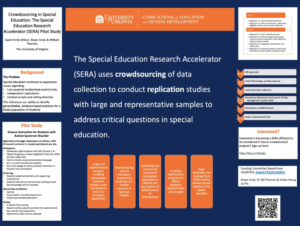
Crowdsourcing in special education: The Special Education Research Accelerator (SERA) pilot study
Presented at the 28th Annual Pacific Coast Research Conference in San Diego, CA.
Research Partner Spotlights
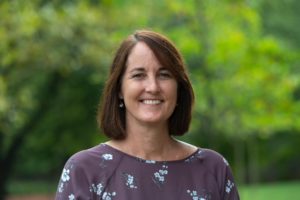
Meet Sheila Conway!
Sheila Conway, Ph.D is an Associate Professor of Practice in the University of Pittsburgh School of Education.

Meet Kimberley Davis!
Kimberley Davis, Ph.D is an Associate Professor of Special Education and Interim Department Chair at Arkansas State University.

Meet Michael Dunn!
Dr. Michael Dunn, is an Associate Professor of Special Education and Literacy at Washington State University Vancouver.
SERA Blog
No Hero Narratives: The Ethos of SERA
One of the seven research teams we worked with throughout the SERA Pilot Study was the team at University of North Carolina Wilmington (UNCW). The UNCW research team included Dr. Amelia Moody, Dr. James Stocker, Dr. Sharon Richter, and Racheal Gliniak (graduate research assistant).

Crowdsource Science: Building a National Infrastructure to Understand Instruction for Students with Learning Disabilities
Crowdsource Science project, a nationally representative observation study funded by the National Science Foundation’s EDU Core Research (ECR) program, aims to illuminate what science instruction looks like for students with learning disabilities, addressing the documented achievement gap and providing insights to better support these learners.
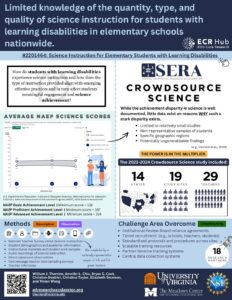
Crowdsource Science: Science Instruction for Students with Learning Disabilities
Crowdsource Science project, a nationally representative observation study funded by the National Science Foundation’s EDU Core Research (ECR) program, aims to illuminate what science instruction looks like for students with learning disabilities, addressing the documented achievement gap and providing insights to better support these learners.
Continue Reading Crowdsource Science: Science Instruction for Students with Learning Disabilities